

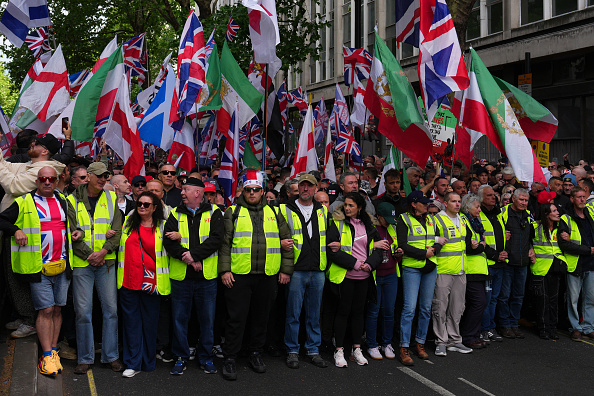



Christian nationalism in Britain is driven largely by people hostile to Islam and immigration and who rarely attend church, according to new research.
Conversely, respondents with actually higher Christian religious observance had lower levels of hostility toward immigration and religious diversity.
The think tank Theos report identified five distinct groups in British society based on attitudes toward Christianity and British identity, drawing on a survey of 1,765 adults conducted in April 2026.
The group whose views most closely aligned with Christian nationalism, labelled “Identity Integrationists”, accounted for 11% of respondents, making it the smallest of the five groups.
Although 81% of Identity Integrationists identified as Christian, only 13% attended church weekly. Less than 31% prayed weekly, while 47% expressed an interest in the Bible.
Rather than focusing on religious observance, the group was more concerned with defending Britain’s Christian heritage.
Just 19% agreed that Christian values required welcoming and supporting asylum seekers, while only 30% supported the equal treatment of religions in public life.
“Their anxiety and ire are focused on Islam and Muslims, with any and all signs of the alleged Islamification of Britain – churches turning into mosques, political influence of Muslims, local influence of Muslims, spread of sharia law, etc. – being powerfully rejected. A remarkably high proportion of Identity Integrationists also believe in the so-called “Great Replacement” theory, the report said. Proponents of the theory believe white people are being deliberately replaced by migrants from Muslim countries.
It added: “When it comes to matters of national identity and pride, it’s important to stress that there is also a substantial racist contingent among Identity Integrationists. 42% of them agree that being white is important to being truly British, and 6% say it is the most important element of being British.
“ Nearly half (45%) say they would be unhappy if they visited their local hospital and most of staff there were from ethnic minorities; 70% say they are proud that Britain “is predominantly white”, and 84% say that Britain is too ethnically mixed.”
Practising Christians more supportive of religious diversity and asylum seekers
The research identified five groups in total:
- Committed Separatists don’t want Christianity to be part of Britishness but don’t have a particularly strong sense of British national identity anyway.
- Cultural Separatists don’t want Christianity to be part of Britishness but are hostile to the idea that any other cultural or religious identity – most obviously Islam or immigrant identities – should occupy that space.
- Values Integrationists do not think you need to be Christian to be British, but they do see Christianity as an important element of British values and want to see that recognised and protected.
- Identity Integrationists see Christianity as fundamental to Britishness and want to defend the nation’s Christian heritage from what they see as invasive and threatening influences.
- Belief Integrationists want to see Christianity integrated with Britishness but, for the most part, because they want to promote the Christian faith rather than preserve Christian values.
“Belief Integrationists”, who had the highest levels of religious observance among the five groups, contrasted sharply with the attitudes of “Identity Integrationists”
Among them, 31% attended church weekly, 46% prayed weekly, and 62% said they were interested in the Bible.
They were also more supportive of religious diversity and welcoming asylum seekers. Almost half (48%) agreed that Christian values required welcoming and supporting asylum seekers, while 63% supported the equal treatment of religions in public life.
Only 18% of Belief Integrationists said defending Britain’s Christian culture and heritage was important to being Christian, compared with 90% of Identity Integrationists.
The report also found wider opposition to religious change among all respondents: 55% said they would be unhappy if their local church closed and became a mosque, including 37% who said they would be very unhappy. More than a third (37%) agreed with the “Great Replacement” conspiracy theory.