

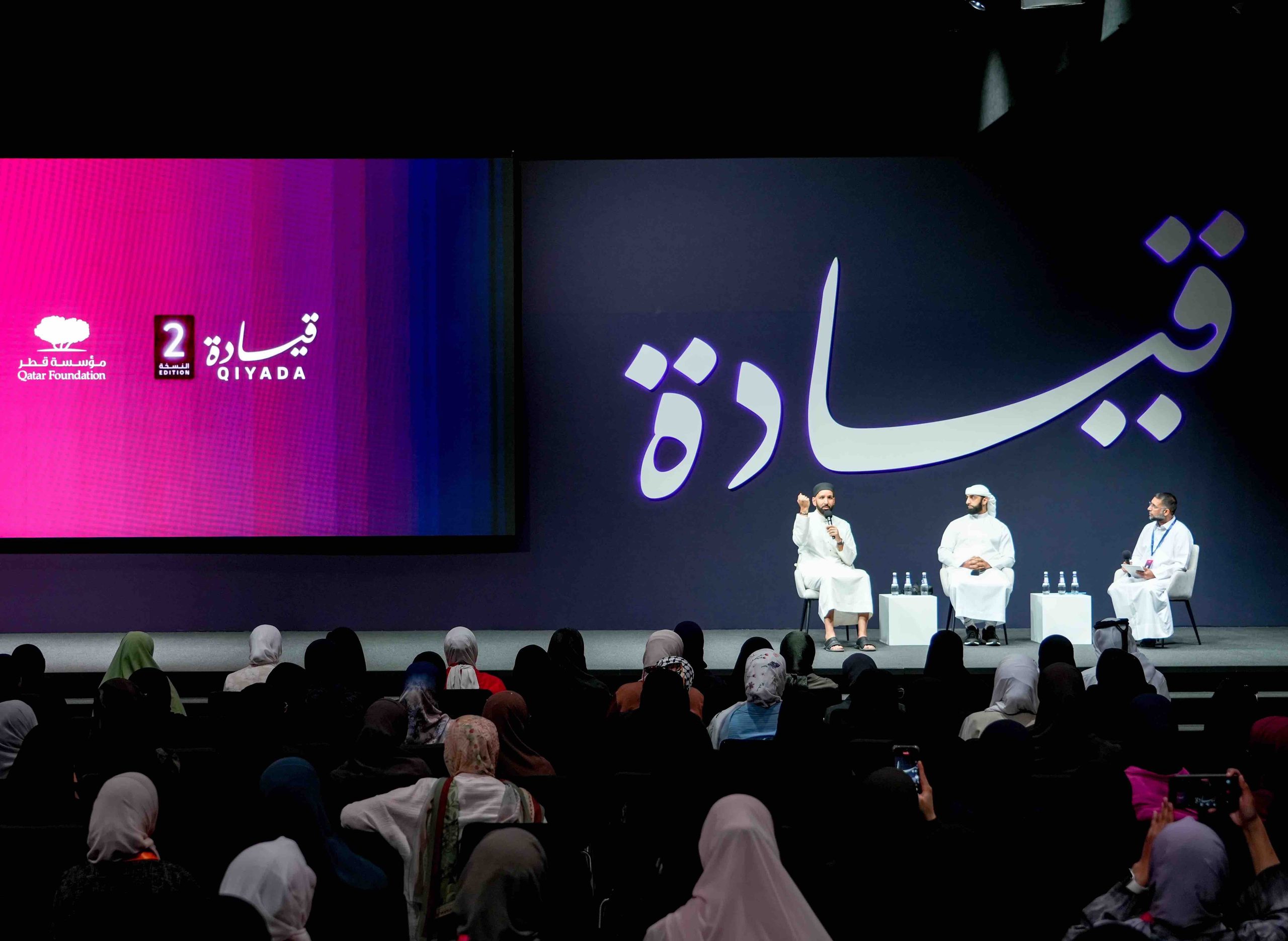



Over 1,300 Muslim youth attended the second edition of QIYADA (Qatar Islamic Youth Aspiration and Development Assembly) to explore faith, identity, leadership, and today’s challenges with scholars, educators, and thought leaders.
The two-day conference, organised by Qatar Foundation, explored how faith can help young people develop their leadership skills and respond to a rapidly changing world.
Among the speakers was Dr Omar Suleiman, who told participants that discipline and leadership are defined not only by what we pursue, but also by what we consciously choose to leave aside
Reflecting on the spiritual weight of restraint, he said that reaching Jannah (heaven) “is actually a lot more about what you don’t do than what you do.” Drawing on a hadith about the nature of true strength, he explained that a strong believer “is not someone that’s able to overcome someone else – their strength is defined by their restraint.”
Dr Suleiman connected this to the concept of leadership, saying: “A leader deletes all that distraction and pays attention to what other people are not paying attention to.
“One of the qualities of leadership is that you look for issues, you look for problems that aren’t being solved, you look for needs that aren’t being fulfilled, you look for voids that aren’t being filled. You are looking constantly for what other people are not looking for.”
And he challenged QIYADA’s young participants to resist distraction and stay focused on what truly matters: “You have to ignore little things in life that don’t matter, in order for you to pay attention to the big things that do matter.”
Harnessing technology for social benefit
Dr Suleiman also took part in a panel discussion alongside Sheikh Ali Hammuda, editor of Islam21c website, and Dr. Osman Umarji, Director of Global Data Studies at Yaqeen Institute for Islamic Research.
Speaking to participants about uncertainty, unpredictability, and the changing world, Dr Umarji said: “You’ve all witnessed change at a rate that prior generations have never experienced.
“We’re seeing Artificial Intelligence and Large Language Models opening opportunities and possibly creating problems. And people are left wondering: how do we function in a world which we don’t know what it’s going to look like tomorrow?”
In another talk, imam and teacher to young adults Sheikh Hisham Abu Yusuf also spoke about technology.
“There is no point talking about leadership if we don’t talk about the new reality of leadership that faces us today – the reality of a digital world,” he said. “The reality is that people don’t exert themselves for answers because everything is known by ChatGPT; the reality of a world where everything is two clicks away.”
He outlined a series of practical steps for young people to consider, including quitting social media for a week and, at the end, calculating how much good they could have done in that time.
And he also encouraged the audience to learn a skill that could harness technology for good, saying: “Think of an issue you see in the world around you – healthcare, poverty, people not understanding the Qur’an, the Arabic language, the breakup of family, marriage.
“There is a long list of problems, but where are the people that are willing to solve them?”
“A true leader is not one who remains unshaken”
Dr Hanan Ahmed Al-Qattan, a specialist in psychological and family counselling, led a talk on ‘The Fragility of a Leader’, where she explained: “A true leader is not one who remains unshaken, but one who wavers yet stands firm; for leaders who conceal their vulnerability do not grow stronger – they become increasingly isolated, and the trust others place in them diminishes.
“People do not place their trust in perfection, but in authenticity. So do not fear your vulnerability; let it be the gateway through which you emerge stronger than before.”
Describing the characteristics of genuine leadership, Dr. Al-Qattan said: “A leader who shows their followers that they share in their pain, rather than standing above them, is the one who instils confidence in them.
“This is not a sign of weakness. Rather, it reflects an awareness of the heavy burden of responsibility – what psychologists today call ‘deep moral awareness’ – and stands as one of the most powerful traits of authentic leadership.”
Educational consultant and lecturer Dr Abdulrahman Al-Harami spoke about the importance of young Muslims finding and being guided by their “compass”,
“What is the thing I am willing to pour my time and effort into? That is your compass,” said Dr. Al-Harami, as he asked the young attendees at QIYADA to look within themselves and assess the value of their time and how they spend it.
“The gift of life is in the time we have, and those who do not know what their compass is will spend their lives lost as to their destination,” he said. “Many of us do not lead happy lives because we are always looking for tomorrow’s happiness. Very few think about how to create quality time for themselves in the now, so that they may look back on their days contentedly.”
Dr. Al Harami urged young people to remember one core principle: do not give up, saying: “Those who persist in something will be known by it. Take your dreams and aspirations seriously and let them be your compass in life.”
The two-day QIYADA conference was organised by the Office of Wellness and Spiritual Life within Qatar Foundation’s Higher Education division, with Qatar International Islamic Bank (QIIB) as official sponsor and the Ministry of Sports and Youth as participant sponsor.