



When I once asked my grandfather about his experience of life in the UK, he said that people “don’t even treat dogs the way they treated me” and that they “didn’t see me as human.”
I wish I could say gone are the “Paki-bashing” days of the 70s and 80s. In recent years, people were still smashing our windows, throwing glass at children, pouring alcohol and acid on us, and assaulting us. This included areas like Basildon, where only 2% of the population is Muslim. I cannot begin to describe the level of violence and terror waged against us.
In the year to March 2025, official Home Office figures show nearly half (45 percent) of all recorded religious hate crimes in England and Wales were against Muslims. Two months ago, when a Muslim woman was deliberately run over, our mainstream media barely reported it — and many other similar instances. Instead, victims and targeted mosques had to publish CCTV footage on their own social media to raise awareness.
When I started as a student at Oxford University after a summer of riots, I knew that nothing worse could happen to me here that hadn’t already happened to me in London.
It was clear to me that many of the Muslims I encountered in Oxford, who grew up in Muslim countries, did not experience the same level of institutional Islamophobia. Nor did they grow up living under the additional layer of fear that the far-right caused for us here. It didn’t shape the trajectory of their lives.
The Oxford Union
During my time at Oxford — and even long before I began studying here — the Oxford Union’s debates surrounding my faith, even at the peak of mounting Islamophobia, have always centred around the same predictable themes. They have focused on whether Islam is a peaceful religion, whether it’s compatible with democracy, and this term, whether the West has a right to be suspicious of Islam.
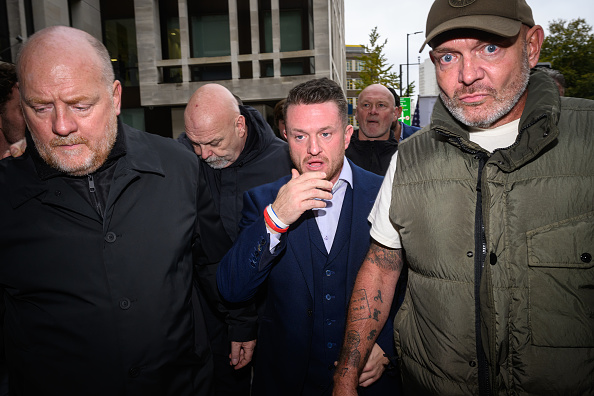
The Oxford Union continuously refers to itself as “the last bastion of free speech.” It is under this banner that Tommy Robinson has been invited — even though it is claimed to have censored Palestinian author Susan Abul Hawwa’s speech in November 2024.
For many, Robinson is the face of the far-right. I personally believe that the rhetoric surrounding him and his ilk contributes to an atmosphere in which anti-Muslim hostility feels increasingly normalised and emboldened.
I still remember being in primary school and watching Tommy Robinson on ITV’s This Morning hold up the Quran and make vile comments on air. His rallies have invited Valentina Gomez, who has filmed herself burning the Quran. She was due to attend the next one but was banned after a backlash.
So how can we seriously act surprised then, when mosques get vandalised, set alight, and Qurans desecrated?
I firmly believe that rhetoric displayed at these marches can contribute to an environment in which some individuals feel comfortable expressing hatred towards Muslims. What role does this broader “mood music” play when individuals attack mosques with axes and hammers, and mount pig heads outside the homes of Muslims?
But again, what’s there to seriously be surprised about? I grew up in an environment where people were already mounting pig heads outside our Mosques.
Selective free speech vs amplification
Some argue that refusing to engage in debate with far-right ideas allows their influence to spread unchallenged. But surely platforming these speakers — especially an academic and intellectually prestigious one like the Oxford Union — gives such ideas legitimacy and reach?
It is not disengagement with these ideas that spreads their rhetoric. It is our engagement, attention, and platforming that provides them with an outlet and validation to continue.
Others may disagree. But after a childhood and adolescence shaped by Islamophobia and the impact of Tommy Robinson rallies, I — like many British Muslims — do not feel obliged to give the Oxford Union the benefit of the doubt, or to justify their decision to invite him.
I don’t think it’s hard to understand how such an invitation reflects a profound lack of thought, respect, and care for the safety of Muslims. Invitations like this inevitably shape the atmosphere we face. If Robinson speaks at the Union and unrest follows, I won’t be surprised. In fact, I am bracing myself for it.
And if I see any of my university friends or coursemates sit through his speech, I know I will lose respect for them. As a visibly Muslim British woman, and the granddaughter of an immigrant, it is very much personal.